MPJE, NAPLEX & PTCB in 2026: The Big Changes Every Pharmacy Candidate Needs to Know
Posted By : Rph Buddy
Pharmacy Licensure & Certification News
The pharmacy licensing landscape just had its most disruptive year in nearly three decades. The UMPJE has gone live, the NAPLEX content outline has been reshaped, and the PTCE has been rebuilt from the ground up — all within a 12-month window. If you’re sitting for any of these exams in 2026, the prep materials you bookmarked last year are already partially out of date.
Here’s a clean, no-fluff breakdown of what’s actually changed across the MPJE, NAPLEX, and PTCB exams — and what it means for how you should study.
1. MPJE → UMPJE: The Uniform Era Has Officially Begun
For nearly 30 years, the MPJE forced candidates to take a separate, state-specific law exam for every jurisdiction they wanted to be licensed in. That era is ending.
What’s new:
- April 1, 2026: The North Carolina Board of Pharmacy became one of the first to require the Uniform MPJE (UMPJE) in place of the state-specific MPJE.
- June 2026: The broader rollout begins, with additional jurisdictions adopting the UMPJE on a rolling basis. Maryland is joining with a state-specific supplemental module; Ohio is winding down its legacy MPJE and adding a state law review course; Kansas is fully discontinuing its state-specific exam.
- July 1, 2026: Select jurisdictions will allow pharmacy students to sit for the MPJE/UMPJE before graduation — a landmark change designed to compress the licensure timeline.
What’s actually on the UMPJE: The exam is built around four content domains covering uniform pharmacy law principles and federal law — not state-specific statutes. Topics include scope of practice, non-pharmacist personnel supervision, prescription processing, controlled substances, and federal regulatory frameworks like DSCSA and DEA requirements.
The catch: During the transition period, some jurisdictions will accept either the legacy MPJE or the UMPJE. Others have already cut off the old exam. Your responsibility as a candidate is to check your specific board of pharmacy’s current policy before scheduling — the rules genuinely vary from state to state, and they’re changing month to month.
If you’re studying for the law exam in 2026, our full UMPJE guide walks through the new content outline domain by domain.
2. NAPLEX: New Content Outline, Pass Rates Climbing
The NAPLEX hasn’t been overhauled like the MPJE, but it’s been quietly evolving — and the data from 2025 graduates is telling a story.
The numbers (released by NABP in February 2026):
- National first-time pass rate for 2025 graduates: 86.8%
- Mean first-time pass rate: 85.7%
- First-time and all-time pass rates have climbed roughly 10% and 13% respectively over the past three graduating classes.
Why the upward trend? A big part of the answer is the updated NAPLEX content outline that took effect for exams administered on or after May 1, 2025. The new blueprint places noticeably greater emphasis on the clinical application of pharmacy knowledge — the Medication Use Process and Foundational Knowledge for Pharmacy Practice domains are where schools have been pouring resources.
Format reminder: The NAPLEX remains a 225-item computer-adaptive exam (200 scored, 25 unscored pretest). Results are reported as Pass/Fail only — no numerical score is released to candidates. The scaled passing threshold is 75.
Study takeaway: Question banks built before mid-2025 are still useful for foundational pharmacology, but you should weight your final weeks of prep heavily toward clinical case-based questions, therapeutic decision-making, and medication safety scenarios. Static review books that haven’t been updated for the new outline will leave gaps.
3. PTCB: The Biggest PTCB Update in Years
If you’re going for your CPhT credential in 2026, this is the section to pay attention to. On January 6, 2026, the Pharmacy Technician Certification Board officially rolled out version 1.4 of the PTCE content outline — and it’s the most significant blueprint change in years.
What changed:
| Domain | Old Weight | New Weight (2026) |
|---|---|---|
| Medications | 40% | 35% |
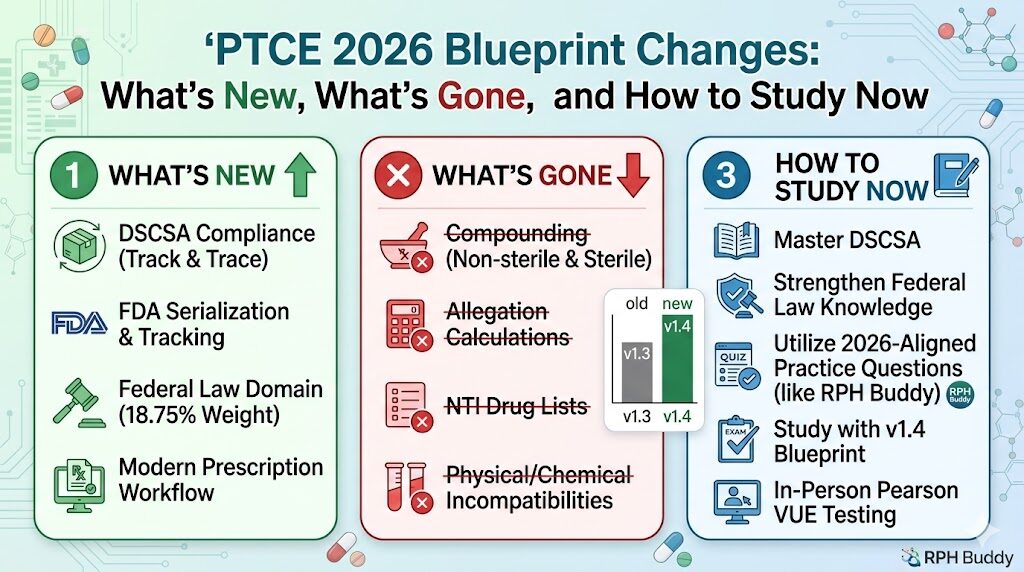
| Federal Requirements | 12.5% | 18.75% |
| Patient Safety & Quality Assurance | 26.25% | 23.75% |
| Order Entry & Processing | 21.25% | 22.5% |
The headline: Federal Requirements jumped 50% in relative weight, driven primarily by new content on the Drug Supply Chain Security Act (DSCSA), which has reached full implementation and now carries real compliance consequences for pharmacy operations.
What was removed:
- Compounding is no longer tested on the PTCE (it’s now covered through PTCB’s assessment-based certificates instead).
- Alligation calculations — gone.
- Narrow Therapeutic Index medication knowledge — removed.
Exam logistics:
- 90 questions total (80 scored, 10 unscored)
- 1 hour 50 minutes total exam time
- Passing scaled score: 1400 on a 1000–1600 scale
- Still delivered in-person at Pearson VUE — online proctored PTCE delivery remains suspended as of late 2025.
Bonus update — Billing & Reimbursement Exam: PTCB also refreshed this credential exam on January 5, 2026, with greater emphasis on medical billing services offered by pharmacies. If you’re chasing advanced credentials, factor this into your timeline.
What This Means for Your Study Plan
If there’s a single theme running through all three of these updates, it’s this: regulatory and federal content is taking up more real estate on every pharmacy exam. DSCSA shows up on the PTCE. Federal law fundamentals are the backbone of the UMPJE. Medication safety and federal regulatory awareness are baked deeper into the NAPLEX clinical scenarios.
A few practical takeaways:
- Verify your prep materials were updated in 2025 or 2026. Anything older has gaps — especially around DSCSA, the new UMPJE content domains, and the reweighted NAPLEX clinical sections.
- Check your state board of pharmacy’s website monthly if you’re testing for the MPJE/UMPJE. Transition rules are moving targets.
- Don’t memorize — apply. All three exams are leaning harder into judgment-based, scenario-driven questions. Question banks that just test facts won’t simulate what you’ll actually see.
- Plan around test windows. If you’re a P4 in a participating UMPJE state, the new pre-graduation testing option (July 1, 2026) could meaningfully change when you start your career.
The exams are harder to game than they used to be — but they’re also more transparent about what they’re testing. Lean into the published content outlines, use updated question banks, and treat the federal/regulatory sections with the respect the exam writers clearly think they deserve.
Have questions about preparing for the UMPJE, NAPLEX, or PTCB in 2026? Drop a comment or reach out — RphBuddy is built by pharmacists who’ve been through the process and stay on top of the changes so you don’t have to.