How to Build a 30-Day Pharmacy Exam Study Schedule (That Actually Works)
Posted By : Rph Buddy
Thirty days sounds like a long time — until you realize your exam is in 30 days.
Whether you’re preparing for the MPJE, UMPJE, CPJE, PTCE, or NAPLEX, the difference between passing and failing almost never comes down to how smart you are. It comes down to how consistently and strategically you studied. A random, panic-driven approach to review rarely works. A structured 30-day plan almost always does.
This guide walks you through exactly how to build one.
Why 30 Days Is the Sweet Spot
Most candidates either over-prepare (burning out weeks before the exam) or under-prepare (cramming the night before). Thirty days gives you enough time to cover all content domains, run practice questions, identify weak spots, and still have time to review before exam day — without completely abandoning your life.
It also matches how most pharmacy board exams are scheduled. Candidates typically receive an Authorization to Test (ATT) and have a window of 60–90 days to schedule. Giving yourself 30 focused days of prep within that window is both realistic and effective.
Before You Start: The Foundation
Before you open a single flashcard or practice question, do these three things.
1. Get the official content outline.
Every major pharmacy exam is built from a published blueprint. The NABP publishes content outlines for the MPJE, UMPJE, and NAPLEX. PTCB publishes one for the PTCE. The California Board of Pharmacy publishes CPJE information through the NABP as well. These outlines list the domains, the topics, and — critically — the percentage of questions drawn from each area. Your study time should mirror those percentages.
2. Take a diagnostic practice test first.
Before you follow any schedule, sit down and take 50–100 practice questions cold. Score yourself honestly. The areas where you score below 60% are your priority zones. The areas where you score above 80% need maintenance, not intensive study.
3. Gather your materials.
You don’t need ten different resources. You need two or three good ones: a primary review resource, a solid question bank, and the official content outline printed out and taped somewhere visible.
The 30-Day Framework
Think of the 30 days in four distinct phases.
Week 1 (Days 1–7): Foundation and Domain Mapping
This week is about coverage, not mastery. You’re touching every content domain so nothing is a complete surprise later.
Go through your primary review resource at a high level. Don’t try to memorize everything — you’re building a mental map. Take 20–30 practice questions each day tied to whatever domain you reviewed that day. Keep a running list of topics that stop you cold or feel unfamiliar.
By the end of Week 1, you should have touched every major domain on the content outline at least once and have a clear picture of where your weaknesses lie.
Daily time commitment: 2–3 hours
Week 2 (Days 8–14): Deep Dive into High-Weight Domains
Now you go deep on the areas that matter most — specifically, the domains that carry the heaviest percentage weight on your exam.
For the MPJE and UMPJE, that means federal drug law, controlled substances scheduling and regulations, DEA requirements, and dispensing regulations. For the CPJE, California-specific law under the B&P Code and Title 16 CCR deserves the lion’s share of your time. For the PTCE, medication safety, pharmacology, and the 2026 content outline updates (including DSCSA compliance) are the priority. For the NAPLEX, therapeutic categories with the most patient encounters in practice take center stage.
Increase your daily question volume this week — aim for 40–60 questions per day. Review every wrong answer in detail, not just the explanation for the correct answer. Understanding why a wrong answer is wrong is often more valuable than knowing why the right answer is right.
Daily time commitment: 3–4 hours
Week 3 (Days 15–21): Targeted Weak Spot Elimination
By now you have two weeks of data on yourself. You know exactly which topics keep tripping you up. Week 3 is about systematically closing those gaps.
Pull your list from Week 1. Take the five to seven topics where you’re still missing more than you’re getting right. Dedicate focused blocks — 45 to 60 minutes each — to those specific areas. Go back to your primary resource, find supplemental explanations, and then immediately follow up with 15–20 practice questions on that topic before moving on.
Also this week: start doing timed practice sessions. Set a timer, simulate exam conditions, and practice pacing. Most pharmacy board exams give you about 1–2 minutes per question. If you’re consistently running long, that’s a skill to fix now, not the morning of the exam.
Daily time commitment: 3–4 hours
Week 4 (Days 22–29): Full-Length Practice and Consolidation
You’re not learning new material in Week 4. You’re consolidating what you know and building exam-day confidence.
Take at least two full-length timed practice exams this week under realistic conditions — no phone, no music, no interruptions. Score them, review every missed question, and look for patterns. Are you missing questions in the same domain? Is it a knowledge gap or a reading comprehension issue (misreading what’s being asked)?
Spend the remaining days of Week 4 on high-yield review: the concepts that appear most frequently across your practice tests, the drug schedules, the key federal thresholds (DEA registration, REMS programs, PDMP requirements), and any state-specific rules relevant to your exam.
Daily time commitment: 3–4 hours
Day 30: The Day Before
Do not cram. Seriously.
Light review only — flip through your notes, review your “I always miss this” list one final time, and call it done by early evening. Get a full night of sleep. Eat a real breakfast. Arrive early.
Your brain consolidates learning during sleep. The last-minute marathon session the night before does more harm than good for most people.
Exam-Specific Tips
MPJE / UMPJE: Focus heavily on the interplay between federal and state law. The UMPJE in particular tests application, not just recall — you’ll be given scenarios and asked what a pharmacist should do, not just what the law says. Know your controlled substance schedules cold, and understand DEA registration, DEA Form 222, and PDMP requirements at a granular level.
CPJE: California law diverges from federal law in meaningful ways. The B&P Code, Title 16 CCR, and California-specific requirements (pharmacist-in-charge responsibilities, collaborative practice agreements, naloxone dispensing without a prescription) are heavily tested. Don’t assume federal knowledge is enough.
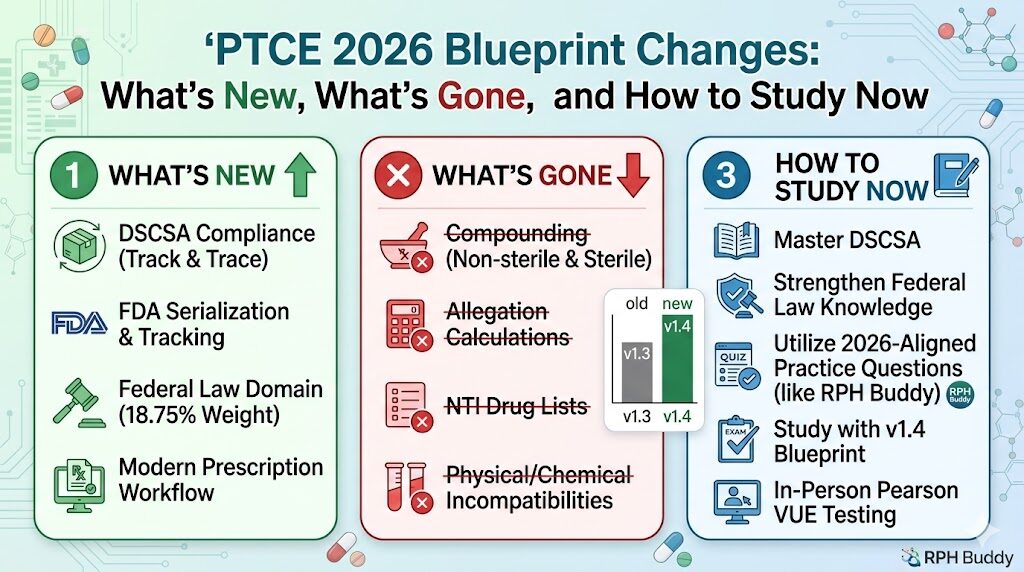
PTCE: The 2026 content outline includes significant updates. DSCSA supply chain compliance is now explicitly tested. Compounding and alligation calculations were reduced. The domain weights shifted. Make sure your study materials reflect the current blueprint, not an older version.
NAPLEX: Clinical application is everything. You’ll need to know not just what drugs treat a condition, but first-line vs. second-line choices, major drug interactions, counseling points, and monitoring parameters.
The One Thing Most Candidates Get Wrong
They spend too much time re-reading and not enough time practicing.
Reading a chapter on controlled substance regulations feels productive. Answering 40 questions on controlled substance regulations and getting 28 right feels uncomfortable — because you have to confront what you don’t know. But that discomfort is exactly where learning happens.
Practice questions aren’t just assessment tools. They’re the most efficient way to encode information. If you’re spending more than 40% of your study time reading vs. answering questions and reviewing explanations, rebalance.
Sample Weekly Hour Allocation
Here’s a simple breakdown of how to split 3 hours per day across study activities:
Week 1: 60 min content review / 60 min practice questions / 40 min answer review / 20 min note-taking
Week 2: 30 min content review / 90 min practice questions / 60 min answer review
Week 3: 20 min content review / 90 min targeted practice / 70 min deep-dive review of missed topics
Week 4: Full-length exams + comprehensive review of missed questions only
Final Thoughts
The 30-day plan works because it’s built around how people actually learn — spaced repetition, active recall, and progressive overload. You’re not grinding through content in a panic. You’re systematically building a knowledge base, stress-testing it against real exam-style questions, and shoring up weak points before they cost you on exam day.
The pharmacists and pharmacy technicians who pass their boards on the first attempt don’t have a secret. They just showed up consistently, practiced more than they read, and trusted the process.
Thirty days. Start today.
Looking for high-quality practice questions for the MPJE, UMPJE, CPJE, or PTCE? RphBuddy offers exam-specific question banks built around the official NABP and PTCB content outlines. Start practicing today.